Modern physical security threats, such as supply chain compromise and insider threats, occur at the intersection of technology, processes, and people. Organizations that understand the need for holistic threat management will be better prepared to mitigate against them.
This article will review the current physical security threat landscape, identify and assess common physical, personnel, and operational security risks, and provide best practices to mitigate these threats.
Summary of key physical security threats
| Threat | Explanation |
|---|---|
| Physical access threats | Tailgating, piggybacking, badge sharing, door propping, credential misuse, and other threats that arise from weak physical access controls or poor access management practices. |
| Environmental and natural hazards | Natural disasters, severe/disruptive weather, and environmental issues. |
| Personnel security threats | Threats arising from negligent, malicious, compromised, or violent employee behavior. |
| Physical supply chain security threats | Threats involving the theft, tampering, diversion, or mismanagement of physical goods, supplies, facilities, transportation routes, and logistics operations. |
| Cyber threats | Ransomware, malware, or Denial-of-Service (DoS) attacks that affect physical security infrastructure. |
| Best practices for mitigating physical security threats | Outline layered defenses, an incident management framework for assessing organizational risk/impact, and a trust-but-verify security culture. |
Types of physical security threats
Physical security threats must be assessed against organizational-specific requirements, including geography, regulatory environment, and operational context. Major disruptions require continuity plans, impact analysis, and a defined escalation threshold. Security practitioners should ensure that, as part of their overall corporate security program, they are aligning with business and operational resilience needs.
Consider the following:
Physical access threats
They can include tailgating, piggybacking, badge sharing, door propping, and credential misuse. These risks can also overlap with digital behaviors when users share logins or fail to lock laptops in shared or sensitive spaces. Weak physical access practices invalidate audit trails and create accountability gaps when organizations need to determine who entered a space, used a credential, or contributed to an incident.
Environmental and natural hazards
Natural disasters, severe/disruptive weather, and environmental issues can impact employee safety and cause potential widespread business disruptions. Risk increases for organizations with data centers or warehouses in hurricane or tornado-prone areas. Internet of Things (IoT) devices should be used to monitor ambient temperature, track assets and manage inventory, and ensure device connectivity.
Workplace hazards
Occupational health and safety regulations are increasingly holding companies liable for high-risk work, unsafe working conditions, and isolated workplaces. Physical security technology is adapting to meet these needs.
Personnel security threats
Employees are an organization's most valuable assets, but also its greatest potential threat. Global organizations need to know where their sensitive areas are, understand working patterns, and have a good handle on operational and cultural factors that impact security. A combination of technical, procedural, and behavioral tools is necessary to prevent incidents.
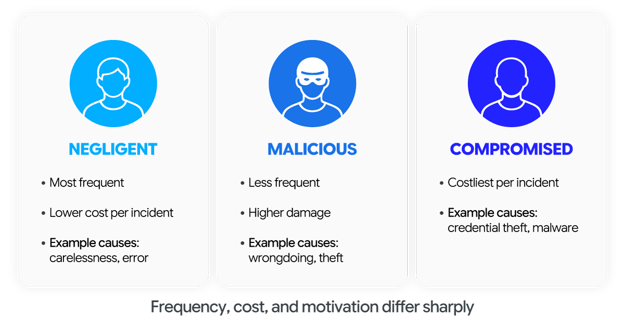
The three faces of insider risk (source)
Negligent
Employees who fail to adhere to security best practices make up the largest category - e.g., door propping, credential sharing, and alarm disabling. This can be due to poor training or security culture, but can be amplified by access control systems that are overly complex or generate excessive false alarms that employees learn to ignore.
Malicious
Employees who act with deliberate intent, stealing assets, sabotaging security infrastructure, or facilitating external attacks. Incidents are typically preceded by behavioral indicators such as:
- After-hours access to out-of-scope areas
- Access pattern shifts following disciplinary events
- Repeated attempts to reach restricted locations with no credible explanation.
Compromised
Employees whose credentials have been exploited without their knowledge, such as through social engineering, proximity card cloning, or phishing. In highly regulated sectors such as government or defense companies, insiders might be targeted due to financial or life stressors.
These insiders are harder to detect as there may be little change in behavior and/or actions. Security practitioners should assess changes in behavior, access control data anomalies, or out-of-the-ordinary requests for access/information.
Workplace violence
Physical threats, harassment, intimidation, and/or other threatening behaviors are prompting increasing legislation requiring organizations to address them. California set a baseline with OSHA SB 553, effective 2024, that requires companies to develop a written Workplace Violence Prevention Plan, annual training, and a categorized violent incident log. This legislation requires:
- Immediate credential revocation upon termination
- Do not admit lists for visitor management systems
- Stringent documentation requirements for incidents.
In India, the POSH Act requires organizations with female employees to maintain an internal complaints committee and implement physical preventive measures such as escort policies, secure transportation, and personal safety technology for employees working late or in isolated locations.
Physical supply chain security threats
Physical supply chain security threats include theft, criminals posing as legitimate shippers, poor security or logistics practices by drivers and vendors, and weak perimeter security at static sites such as warehouses.
High-value thefts, shrinkage, product tampering, and diversions cost companies in both revenue and reputational damage. For example, in the US, cargo theft is estimated to be a multi-billion-dollar industry.
Cyber threats
Ransomware, malware, and Denial of Service (DoS) attacks can impair access to CCTV systems, disrupt device connectivity for Physical Access Control (PACS), or create unintended backdoors in physical IT infrastructure. Damaged, stolen, or compromised digital networks or systems have real-world implications for physical security infrastructure. Security practitioners must ensure that they have adequate procedural and process controls in place, systems to monitor device outage and health, and operational plans to support long-term system outages.
No single control can address the full physical threat landscape, but an integrated system of tools, governance, and culture is better positioned to mitigate these threats.
Implement a layered defense
Layered defense means multiple overlapping controls, each working with and supplementing the limitations of the others. The layers should be built to align with technology, personnel, and processes.
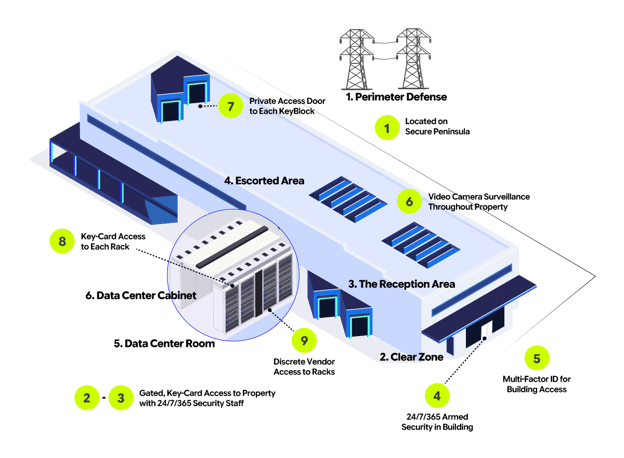
Layered security requires overlapping technology, people, and processes to reduce physical security threats. (source)
Perimeter layer
Fencing, bollards, vehicle barriers, perimeter CCTV, and IDS establish the outer boundary. The objective is deterrence and early detection. Identify a threat as far from the facility as possible to maximize response time. Smart perimeter technology, such as sensor-integrated fencing and automated bollards with license plate readers, can reduce dependence on physical patrols.
When integrating multiple systems, implement monitoring technology to ensure device states, firmware updates, and operational configurations are aligned.
Building layer
Card readers, turnstiles, mantraps, and visitor management systems control entry. Access rights should be role-based, time-restricted where appropriate, and reviewed against current employment and role status on a defined cycle.
Most importantly, they should be integrated with the organization's HR system to enable the centralized disabling of access rather than manual removal. Incidents requiring further investigation by security practitioners include:
- After-hours access frequency spikes
- Failed badging attempts to reach restricted areas
- Unusual access requests following HR events
Organizations need solutions in place to monitor device health and ensure badge data is not corrupted or compromised.
Interior layer
CCTV, PACS, IoT monitoring (such as ambient temperature), and restricted-access requirements ensure that sensitive, high-value, and controlled areas are monitored and have additional layers of control. Physical security practitioners should consider using behavioral analytics coupled with an emphasis on incident reporting to monitor changes in employee behavior.
As new device types and integrations leverage traditional CCTV/PACS systems, security practitioners need a unified device management platform that monitors physical security and environmental sensors in a single dashboard.
Personnel layer
Security personnel, such as a guard force, still have a role within a technology-driven physical security program. Security officers provide incident response/reporting and, if trained correctly, can provide a useful physical response.
Security programs should prioritize quality over quantity and develop a guard force program that uses training, documentation, and process-driven workflows to help security officers deliver better response capabilities.
Documentation layer
Good governance and documentation are essential for a corporate security program. Security practitioners should focus on developing clear, consistent policies, standards, and processes that meet the business's needs.
For example, if the company has a global footprint, rather than each office developing its own access control procedures, security practitioners should adopt a top-down approach that prioritizes high-level principles adaptable to any specific context.
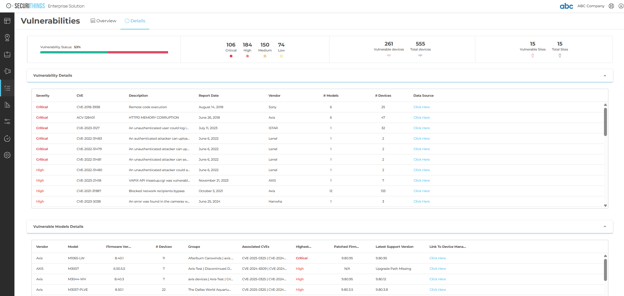
Modern platforms ensure that perimeter, building, and interior layers are monitored on a single dashboard. (source)
Develop an incident management framework
A physical security program without a defined incident/threat management framework will be reactive and inconsistent. When the security program does not know how to triage, classify, and assess incident types, responses will be ad hoc. Escalations will be slower, documentation will be weak, and the security program will be unable to see the complete threat picture.
Incident classification
Categorize incidents by type and severity. A device outage, an unauthorized access event, a workplace violence incident, and a supply chain disruption each require different resources and escalation paths. Classification must be standardized across all sites so that incident data is comparable over time and across locations.
Response workflows and cross-functional notification
Define who is notified, in what sequence, and what they are responsible for doing. Security incidents should have clear workflows for notifying HR, Legal, IT, Facilities, and Operations. Security practitioners should work with these stakeholders to determine and define actions and response protocols during incidents.
Documentation
Every incident generates a logged record that includes a summary of what occurred, who responded, and what they did, and any after-actions that are required. Post-incident reviews should be conducted both internally and externally, depending on the criticality and/or severity of the incident.
Threat assessment
Incident data should feed back into the threat assessment process, such as patterns of after-hours unsecured doors or badging sharing, recurring thefts of goods and/or in specific areas, or a high number of slips and trips, which necessitate that the risk assessment of underlying threats be done.
Build a trust-but-verify culture
Trust but verify applies to physical security as directly as it does to cybersecurity. Routinely audit and reassess authorized access and approved individuals.
Employee offboarding
Automate credential deactivation to happen shortly after the termination conversation - not at the end of the business day or when the ID badge is returned. Automate offboarding protocols, and in the event of a high-risk termination, an established protocol among line managers, HR, and the corporate security department should be agreed upon and implemented.
Security practitioners should work with their stakeholders to develop processes that can be consistently applied and socialized to ensure there are no gaps.
Vendor and contractor scope of works
Third parties with physical access to facilities should operate under written agreements that specify the areas they can access, hours of access, personnel vetting standards for their staff, and security incident reporting obligations. These requirements should be assessed at vendor onboarding and at each periodic vendor review.
Security awareness culture
Employees should be trained and need to understand that they are each responsible for security. Corporate security programs should focus on building a security culture. This should encompass scenario-based learning management system training that is annually refreshed and directly delivered to people who are frequently in violation. Security practitioners should also consider corporate and/or monetary recognition for security best practices, particularly for employees who challenge those without badges and/or who refuse to allow tailgating or piggybacking.
Conclusion
The physical security threats target not only the physical but also the personnel and operational security of an organization. Corporate security programs need to prioritize layered security defenses, a clear incident management methodology, and security awareness and training for proactive prevention and mitigation.
Security technology will continue to be a foundational part of the threat management process, and maintaining operational visibility across the physical security infrastructure is key.