Physical security protects people, property, and assets from threats such as theft, vandalism, natural disasters, and unauthorized access. A physical security policy is a formal statement from organizational leadership that sets expectations, defines authority, and establishes accountability for protecting these assets.
According to the Cybersecurity and Infrastructure Security Agency (CISA), security policies provide the strategic direction that guides the development of standards, plans, and procedures. When backed by leadership and consistently applied, a physical security policy does more than set rules; it demonstrates organizational commitment to the physical security program, reduces risk, enhances resilience, and helps ensure continuity of operations.
This article outlines the essential elements of a strong physical security policy, introducing the four guiding principles of deter, detect, delay, and respond. It provides best practices that security managers can apply to implement and maintain an effective program.
Summary of key physical security policy concepts
| Concept | Description |
|---|---|
| Controls and safeguards | Access controls, surveillance systems, and environmental protections form the practical layers of defense that secure facilities and support business continuity. |
| Crime prevention through environmental design (CPTED) | Designing spaces with natural surveillance, clear boundaries, and intentional layouts discourages intrusions while making facilities safer and more welcoming for authorized users. |
| Deter, detect, delay, respond | These four pillars of physical security work together to deter threats through visibility and design, detect intrusions quickly, delay attackers with barriers, and respond effectively through coordinated actions. |
| Leadership and risk foundations | Strong policies start with executive support and a risk assessment process that identifies critical assets, likely threats, and vulnerabilities to guide protective measures. |
| People and awareness | Employees, contractors, and vendors must be trained and held accountable, since human behavior is often either the strongest or weakest link in physical security. |
| Testing and continuous improvement | Regular drills, tabletop exercises, and audits validate that the policy works in practice and ensure that it evolves to address new risks and organizational changes. |


Monitor the health of physical security devices and receive alerts in real-time

Automate firmware upgrades, password rotations & certificate management

Generate ad hoc and scheduled compliance reports
Leadership and risk foundations
A physical security policy is only as strong as the leadership and risk analysis behind it. Policies written without executive backing or a clear understanding of threats often fail to gain traction.
Executive commitment
Leadership support provides the authority, resources, and visibility needed to make a policy effective. When executives endorse security measures, adhere to its policies, and allocate budget appropriately, it signals to employees that security is a priority. A policy backed by leadership has weight across the organization, ensuring consistent application at every site and department. 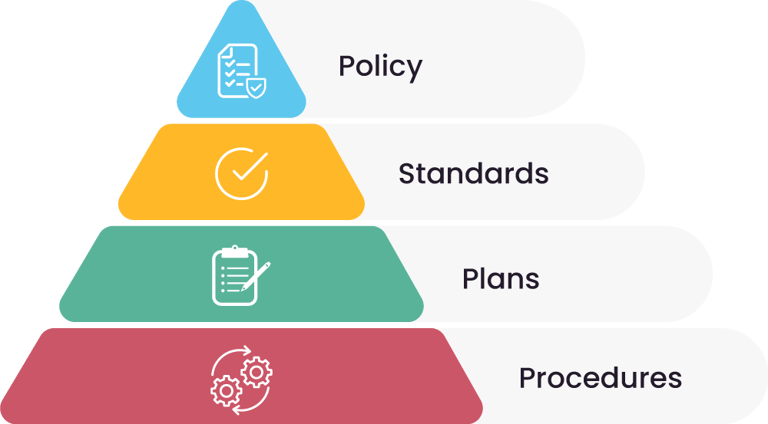
From policy to procedure, this hierarchy shows how strategic intent becomes actionable guidance across an organization.
Risk assessment
Policies should be rooted in a formal process that identifies what must be protected, what can go wrong, and what the impact would be if protections fail. This includes assets such as people, facilities, and information; threats like theft, workplace violence, or natural disasters; and vulnerabilities like unmonitored entrances or outdated technology. Regular risk assessments help prioritize investments, align protective measures with actual needs, and let the organization avoid wasting resources on low-impact risks.
Together, executive sponsorship and risk-driven planning form the foundation on which every other element of a physical security policy is built.
Deter, detect, delay, respond
A physical security policy should be structured around the four classic principles of protection: deter, detect, delay, and respond. These principles create a layered defense that discourages threats, identifies intrusions quickly, slows attackers, and enables swift action when incidents occur. The policy should also make clear that controls are appropriate to the level of risk identified in the organization’s risk assessment. A low-risk area may only need basic safeguards, while higher-risk environments justify more advanced measures.
Equally important is ensuring that the security team’s view of risk aligns with that of organizational stakeholders. Overstating or underestimating risk can erode trust, lead to misplaced priorities, or result in resistance to security initiatives. Policies should encourage collaboration during the risk assessment process, bringing in business leaders and stakeholders to validate assumptions and agree on acceptable risk levels. This shared understanding ensures that physical security measures are both proportional and supported across the organization. 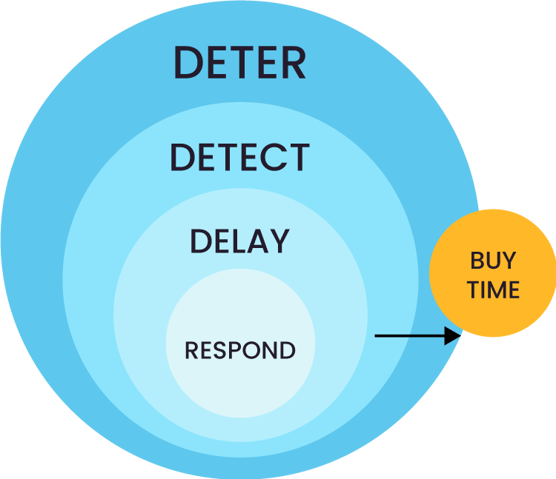
The four pillars of physical security work together to buy critical time, allowing organizations to prevent, identify, and mitigate threats before they escalate.
Deter
Policies should mandate visible and environmental measures that discourage threats, but only where risk warrants them. For example, exterior lighting and signage may be sufficient in a low-risk office park, while higher-risk facilities may require fencing and a visible guard presence. Policies should also integrate crime prevention through environmental design (CPTED), ensuring that site layouts reduce opportunities for crime through design choices. Examples of this include:
- Requiring natural surveillance (lighting, windows, cameras) in higher-risk zones
- Defining territorial boundaries with landscaping or fencing appropriate to the site’s risk profile
- Directing foot traffic toward monitored entry points
- Setting maintenance standards to reinforce that areas are actively overseen
Detect
Policies should require detection capabilities that are proportionate to the risks identified. In some environments, periodic guard patrols may be sufficient, but in higher-risk facilities, continuous video monitoring, intrusion detection systems, and real-time alerting may be necessary. The policy should also specify standards for data retention, assign responsibility for monitoring, and define escalation procedures once suspicious activity is identified. These requirements ensure that detection efforts scale with the potential consequences of an incident.
Effective detection directly influences how quickly and accurately an organization can respond. However, maintaining situational awareness across large, distributed environments can be challenging. Security teams often struggle with managing high volumes of alerts from disconnected systems, leading to missed or delayed responses. Policies should encourage integration and centralized visibility across all monitoring systems to reduce blind spots and improve response coordination.
Equally importantly, the policy should include training requirements for the personnel responsible for monitoring and responding to alerts. Even with advanced detection tools, effectiveness depends on operators’ ability to interpret data, distinguish genuine threats from false alarms, and follow established escalation procedures. Regular refresher training and simulated alert drills can help ensure that monitoring staff maintain the proficiency needed to respond quickly and accurately when incidents occur.
Modern platforms help organizations maintain visibility and operational health across large fleets of physical security devices. By ensuring that detection systems remain online, patched, and properly configured, such solutions enhance both detection reliability and the speed of response when incidents occur.
Delay
Delaying measures buy responders time, but the level of control must reflect the threat. A low-risk office may only require keycard access on exterior doors, while a data center or laboratory may need dual authentication, reinforced doors, or mantraps. The policy should guide decision-making by requiring that barriers be commensurate with the criticality of assets and the likelihood of threats identified in the risk assessment.
Respond
Policies must outline how incidents will be managed and calibrated to the risk environment. For example, a small office may focus on evacuation and local law enforcement coordination, while a large critical facility may require a complete incident command structure, lockdown protocols, and integration with regional emergency responders. Policies should also require after-action reviews to ensure that lessons learned are incorporated into the risk assessment and policy updates.
Controls and safeguards
A physical security policy becomes actionable when it defines the categories of controls that organizations must implement. These controls should always align with the risk assessment findings, ensuring that resources are applied proportionally to the threats and vulnerabilities present.
Access control
The policy should establish how employees, contractors, and visitors are authenticated and authorized. In low-risk areas, this may mean basic card or key access. In higher-risk environments, biometric authentication, dual-factor verification, or mantraps may be required. The policy should also address credential lifecycle management, including issuing, revoking, and auditing access rights.
Many organizations require personnel to wear identification badges visibly above the waist at all times, allowing others to quickly verify authorization. Individuals not displaying a badge should be politely stopped and questioned. To make identification even easier, some organizations use color-coded lanyards to indicate a person’s status: red for full-time employees, blue for vetted contractors with approved access, and yellow for visitors who must be escorted at all times. This approach is especially valuable in large facilities or environments with frequent visitors, where not everyone knows one another and visual cues can help prevent unauthorized access.
Surveillance and monitoring
Cameras, sensors, and alarms provide visibility and evidence for investigations. The policy should define where surveillance is required, how long footage is retained, and who is responsible for monitoring. It should also include requirements to protect these systems from cyber exploitation, since IP-based devices can introduce new risks if not adequately secured.
Environmental and safety protections
Physical threats are not limited to intrusions: Fire, flood, storms, and power outages can be equally disruptive. The policy should require safeguards appropriate to the risk profile of each site, such as fire suppression systems, backup power, water leak detectors, and emergency lighting. These measures help maintain continuity of operations and compliance with safety standards.
For infrastructure entities governed by NERC operators, physical security policy must also account for CIP compliance. SecuriThings’ Guide to NERC CIP Compliance and Physical Security provides more detail on these requirements.
Third-party and vendor security
Vendors, contractors, and service providers often need facility access, and they must be held to the same security standards as employees. The policy should require vetting, temporary or restricted credentials, escorts in sensitive areas, and clear contractual obligations for security. This reduces the risk of introducing vulnerabilities through third parties.
| Risk Area | Example Control | Validation Method |
|---|---|---|
| Unauthorized Entry | Access controls that require dual-factor authentication | Audit access logs quarterly |
| Equipment tampering | Video surveillance | Random video reviews |
| Fire | Fire suppression, alarms | Annual safety system testing and inspections |
| Vendor access | Escort and temporary badge | Review of logs and video surveillance |
People and validation
Technology and barriers are only part of a security program. A physical security policy must also address the human element and establish processes to check that controls work as intended.
Training and awareness
Even the best-designed security system can fail if employees, contractors, and vendors don’t understand their responsibilities. The policy should require initial and recurring training tailored to the risk environment. This includes how to use access systems, how to recognize and report suspicious activity, and what actions to take in emergencies. Awareness campaigns, signage, and drills reinforce the message that security is everyone’s responsibility.
Testing and validation
A policy must go beyond requiring controls on paper; it must also require proof that those controls are effective. This can be done through audits, inspections, and penetration testing of physical barriers and systems. Tabletop exercises are particularly valuable, allowing teams to walk through simulated incidents in a low-cost, discussion-based format.
For example, a recent security drill at a manufacturing facility revealed that while perimeter alarms were functional, the internal door sensors had been offline for weeks due to a configuration error. Discovering that issue in an exercise rather than during an actual breach allowed the organization to correct the problem and refine its maintenance checks.
To maintain this kind of continuous assurance, policies should encourage the use of automated monitoring and audit tools that verify device health, configuration, and compliance in real time. Platforms such as SecuriThings can help security teams streamline these validation efforts by continuously monitoring the operational status of cameras, access controls, and other connected devices, ensuring that issues are detected and resolved before they impact readiness.
Continuous improvement
Threats, technologies, and operations evolve. The policy should mandate regular reviews and updates to align with the current risk landscape. After incidents, drills, or major organizational changes, teams should document lessons learned and use them to refine procedures.
To make this process measurable, policies should define review cycles and key performance indicators (KPIs) for assessing effectiveness, such as audit completion rates, device uptime, or the average time to resolve identified security issues. These metrics help ensure that improvements are tracked, verified, and sustained over time.
Analytics and monitoring platforms can support continuous improvement by providing real-time visibility into device performance, compliance trends, and operational health. Using this data-driven insight, organizations can identify recurring issues, adjust priorities, and evolve their policies before minor gaps turn into significant vulnerabilities.
Treating the policy as a living framework that has measurable goals and continuous feedback, keeps the security program resilient over time and prevents it from becoming a “check-the-box” exercise.
Last thoughts
A physical security policy is more than a list of controls. It is a leadership-driven framework that ensures protective measures are aligned with real risks, applied consistently across the organization, and continuously refined over time. By anchoring the policy in risk assessments, embedding the principles of deter, detect, delay, and respond, and supporting the policy with well-defined controls, training, and validation, organizations can strengthen both resilience and confidence.
The most effective policies are those that are tested regularly, adapted to changing threats, and supported at every level of the organization. Done well, a physical security policy safeguards not just assets and facilities but also the safety of people and the continuity of operations.
Modern device management and monitoring platforms help operationalize these principles by providing continuous visibility into the health, configuration, and compliance of security devices. Beyond visibility, they also enable organizations to remotely remediate issues and automate maintenance tasks that keep systems operational, cyber-protected, and compliant.
By centralizing data and automating routine checks, organizations can detect issues before they escalate, ensure that policies are enforced consistently, and maintain the ongoing assurance needed to keep pace with evolving risks. This convergence of policy, technology, and analytics represents the next stage of physical security maturity, transforming policy from a static document into a dynamic, measurable practice.