For years, organizations viewed physical security as a necessary expense, a function focused on compliance and protection rather than its impact on business. However, physical security teams are increasingly being asked to do more than secure facilities and comply with regulations.
Across industries, organizations are discovering how physical security data can drive business value. For example, retailers utilize camera analytics to manage inventory and enhance the customer experience, manufacturers detect machine faults before they halt production, and airports monitor passenger flow to reduce congestion.
This guide explores this transformation, focusing on how enterprises can identify physical security value drivers and mature their programs from reactive protection to strategic partnership with business managers, through collaboration, measurable ROI, and a roadmap with milestones.
Summary of key concepts for using physical security to drive business value
The table below summarizes the three sections of this guide that will explain how modern organizations can use physical security to drive business value.
| Guide section | Summary |
|---|---|
| Security as a strategic business driver | Security data used as operational intelligence to improve throughput, utilization, and experience across retail, airports, campuses, stadiums, and manufacturing, linked to business KPIs and weekly decisions. |
| Cross-functional collaboration | Shared dashboards, tickets, and runbooks across security, IT, InfoSec, and compliance to reduce handoffs, speed up response, strengthen audit posture, and turn security signals into an enterprise asset. |
| Enterprise security maturity model | Progression from reactive to collaborative programs, with characteristics, operating practices, and metrics at each stage to guide advancement. |


Monitor the health of physical security devices and receive alerts in real-time

Automate firmware upgrades, password rotations & certificate management

Generate ad hoc and scheduled compliance reports
Security as a strategic business driver
Modern security programs must feed the enterprise with actionable operational intelligence. When it comes to physical security, the same devices that protect people and facilities also store information that can enhance customer experience. In the sections below, we'll explain how this trend is emerging across industries in seven different examples of physical security value drivers.
Retail: on-shelf availability and conversion
Retailers are transforming security cameras into operational tools: shelf-mounted and dome cameras detect low stock and planogram gaps, activate out-of-stock alerts, and replace manual gap inspections. The same analytics track shopper flow to adjust labor in real time, opening lanes and reallocating staff to busy aisles, while digital gap scans provide headquarters with more accurate demand signals for better inventory management.
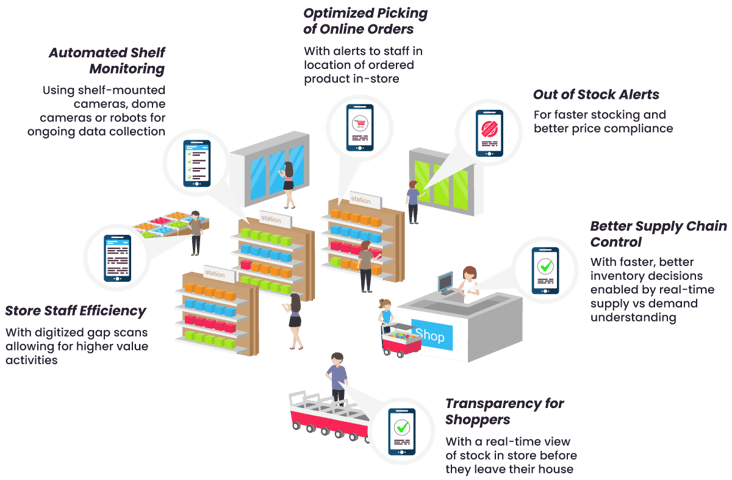
Retail: From security video to store intelligence. Shelf cameras trigger out-of-stock alerts, guide staffing, and feed better inventory decisions. (Source)
The key performance indicators (KPIs) are straightforward: increased on-shelf availability improves conversion rates, smarter staffing reduces queues and raises basket size, and clearer signals to the supply chain prevent stockouts and markdowns.
Airports: queue reliability and passenger flow
Airports use footfall (passenger flow) analytics to determine where people are, how long they wait, and how they move, and then act in real time. Systems measure dwell times and queue lengths, send alerts when lines build or areas crowd, and push guidance to staff dashboards so teams can open counters, redirect passengers, or even reroute flows between terminals. Beyond headcounts, this combines location intelligence with context to enhance layouts, signage, and wayfinding, transforming passenger movement data into informed decisions that reduce bottlenecks and streamline the journey.
Primary KPIs include average and worst-case queue time, time to action on alerts, overflow event count, and before/after heatmaps.
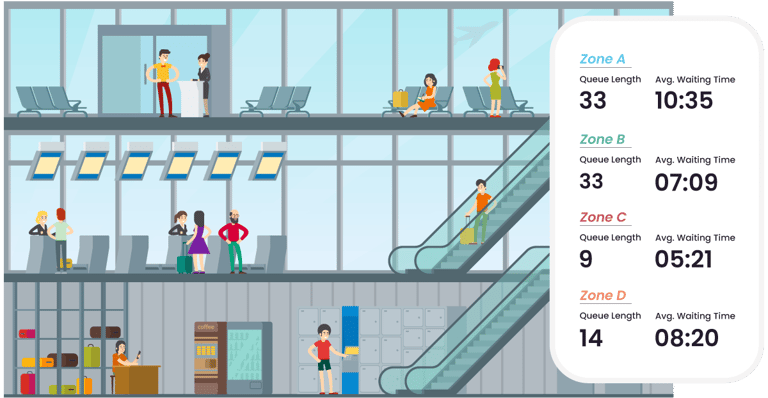
Real-time queue and wait-time visibility. Live zone dashboards help teams open counters, redirect flows, and reduce bottlenecks (Source)
Education: space utilization and event routing
Educational campuses are using the same security infrastructure to run the campus more smoothly, not just more safely. Access logs and video analytics highlight tailgating and propped doors, while occupancy heatmaps show which buildings, floors, and lecture halls are over- or underused throughout the day.
During events, crowd-flow dashboards enable security and facilities teams to direct foot traffic, open additional entrances, and adjust shuttle routes in real-time. Tying these signals into scheduling and facilities systems leads to smarter room assignments, faster maintenance response (e.g., cleaning after high-use blocks), and better emergency coordination (who's likely inside, which routes are congested). The result is fewer class bottlenecks, a better student experience and safety, and more efficient use of space and staff time.
Primary KPIs include room utilization by time block, door-prop incidents per week, time to secure after alert, and on-time class starts.
Stadiums and venues: ingress, egress, and per-fan spend
Stadiums are a clear example of security data powering operations and revenue. The same cameras, access points, and occupancy sensors used for crowd safety also feed live queue monitoring, in-stadium navigation, and order-from-seat workflows, which cut wait times and increase per-fan spend.
Facilities teams use these signals to allocate resources (e.g., gate staffing, ushers, cleaning, parking flow), while venue ops adjust seating and concourse routing in real time to prevent bottlenecks. Security infrastructure becomes a control layer for the whole venue, improving the fan experience, increasing throughput, and supporting marketing/ticketing decisions.
Primary KPIs include gate throughput, average wait by gate or concourse, order completion time, and transactions per interval.
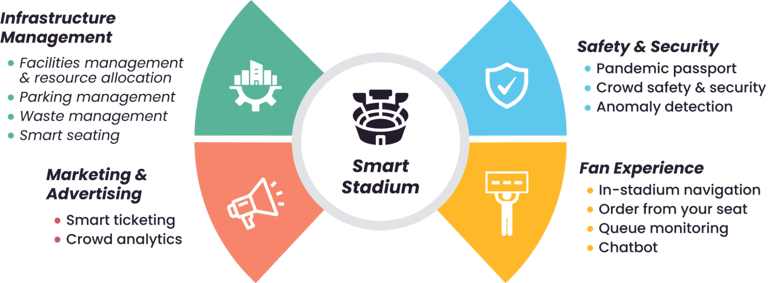
Queue monitoring, in-stadium navigation, order-from-seat, and resource allocation turn venue cameras/sensors into real-time operations and revenue tools. (Source)
Logistics: yard and door utilization and turn time
In distribution yards, camera feeds, RTLS, and yard-management systems expose real-time congestion, trailer dwell, and door availability. Dispatchers adjust routing and dock assignments based on this visibility, cutting search time and idle dwell while smoothing outbound schedules across shifts.
When these signals are integrated into standard operating procedures, the result is fewer surprises, faster turns, and better use of doors and labor. Continuous measurement, rather than sporadic time-and-motion studies, keeps improvements durable. Primary KPIs include average dwell time, dock-door utilization percentage, variance against booked appointments, and on-time departures.
Manufacturing: downtime and first-pass yield
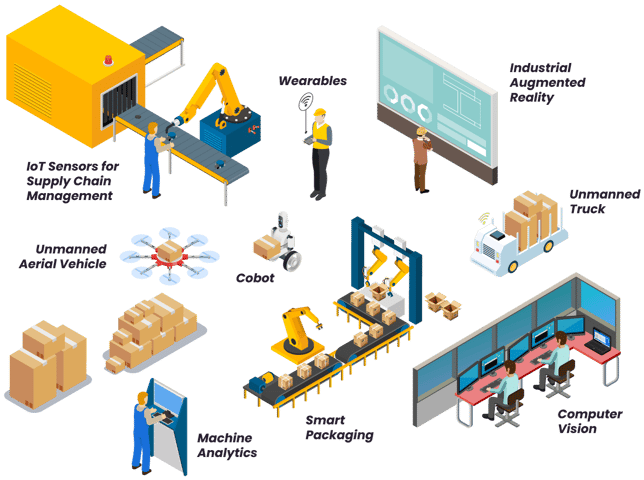
Manufacturing intelligence at the edge. Connected devices track parts, detect issues early, and keep lines moving from receiving to shipping. (Source)
In manufacturing, the same cameras and sensors used for security can provide the production team with helpful signals. Computer vision detects defects or counts mistakes, machine sensors warn before equipment fails, and trackers indicate the actual location of parts, tools, and pallets. This helps planners schedule maintenance before breakdowns, keep lines moving, and ensure timely shipments. Security devices become a live data layer that enhances quality, reduces downtime, and optimizes the flow from receiving to shipping. Primary KPIs include unplanned downtime (events and minutes), mean time between failures, first-pass yield, and schedule adherence.
What changes in a value-driven program is the link to business KPIs. Security data is correlated with metrics like in-store conversion, average transaction value, passenger throughput, class attendance rates, guest satisfaction, overall equipment effectiveness (OEE), and unplanned downtime. This tightens the connection between field reality and management decisions, such as adjusting planograms, rebalancing shift rosters, or sequencing maintenance to prevent failures.
Camera analytics, access systems, and device telemetry matter insofar as they deliver timely, trustworthy signals that business owners can act on. The emphasis for leadership is governance (who owns which KPI), integration (how security data lands in the systems teams already use), and cadence (how insights drive weekly decisions).
Security evolves from a cost of control to a producer of measurable value, supporting revenue, protecting margin, and improving the experience for customers, employees, students, travelers, and fans alike.
Cross-functional collaboration
Physical security creates the most value when its signals don't end at the security desk. When camera health, access events, and device telemetry are integrated into the same systems that IT already uses for monitoring and ticketing, teams act on a single version of the truth, reducing handoffs and closing gaps. Bringing compliance into that loop turns evidence gathering from a retroactive chore into a live process: retention status, change records, and access logs are attached to the same case as it unfolds, so audits are faster and less painful.
A practical way to operationalize this is to establish a small, standing working group with clear roles, such as security, IT InfoSec, HR, Legal, and Compliance. Security provides physical events and device context; IT handles discovery, patching, segmentation, and service health; HR manages training and people workflows; legal and compliance align policy, retention, and investigations with regulatory requirements. This structure prevents duplicated work (three teams chasing the same incident separately) and accelerates decisions because ownership and escalation paths are defined in advance.
Before we map specific workflows, it helps to anchor on the essentials of a cross-functional team: diverse expertise, clear objectives, a collaborative environment, and effective leadership.
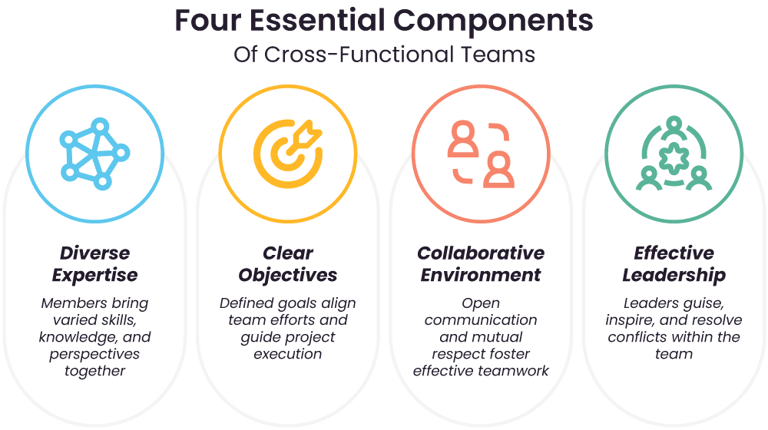
Diverse expertise, clear objectives, a collaborative environment, and effective leadership turn shared data and runbooks into results. (Source)
The table below translates these principles into concrete collaboration mechanisms, owners, and outcomes.
| Collaboration mechanism | Who's involved | What actually happens | Value created |
|---|---|---|---|
| Unified alerts & tickets | Security, IT, Compliance | Physical events and device health generate one ticket with linked video, access logs, and change records. | Faster response, fewer handoffs, audit-ready evidence |
| Insider-threat working group | Security, IT InfoSec, HR, Legal, Compliance | Defines indicators (e.g., anomalous access + door props), coordinates investigation & HR actions | Early detection, consistent process, lower legal/regulatory risk |
| Device lifecycle in IT | IT and InfoSec, Security | Cameras/readers treated as endpoints: inventory, patching, backups, monitoring, MFA for admins. | Higher uptime, fewer blind spots, aligned policies |
| Privacy-by-design sharing | Compliance, Security, Ops | Share occupancy/flow trends with identities masked; enforce retention by policy | Operational insight without privacy exposure; more transparent governance |
| Post-incident reviews | All above | 20-minute debriefs feed fixes to playbooks, training, and controls | Continuous improvement; less rework on future cases |
Daily, this looks like shared dashboards and runbooks: a forced-door alert opens one ticket visible to all; if a camera goes offline during an incident, IT sees it as a monitored asset and can remediate while security continues response; compliance watches the chain-of-custody build itself (clips, logs, approvals) rather than requesting it later. Over time, the group conducts brief post-incident reviews to refine controls, training, and playbooks, turning incidents into opportunities for improvement rather than recurring tasks.
Enterprise security maturity model
Organizations don't leap from "cost center" to "value driver." They progress incrementally. In the Reactive stage, teams put out fires with little to no device visibility, camera outages are often discovered during incidents, evidence is manually retrieved, and fixes are implemented ad hoc.
Preventive programs include basic checks using manual tools (spot health audits, spreadsheet inventories, and ad hoc clip retention). Visibility improves, but it's still siloed by site or system, and response depends on people noticing problems.
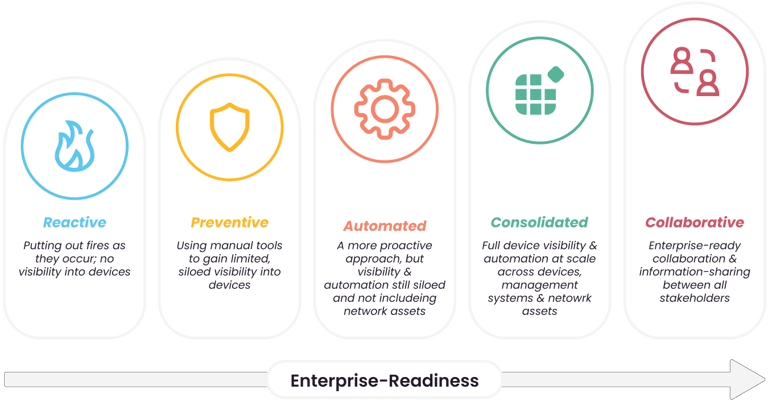
Five-stage maturity model: Enterprise readiness increases as visibility, automation, and information-sharing expand across devices, systems, and network assets. (Source)
The shift begins at the Automated stage. At this stage, continuous health monitoring, firmware alerts, and policy checks are performed across the fleet, but their value diminishes when these tasks operate in isolation. Extend automation end-to-end: automatically discover every device, monitor health and configuration continuously, enforce baselines for passwords, certificates, logging, and retention, and execute firmware and certificate changes through change control.
Platforms like SecuriThings unify these workflows and surface them in ITSM and SIEM monitoring, enabling Security, IT, and Compliance to act on the same signal with shared ownership and audit-ready evidence. The result is fewer blind spots, faster time-to-fix, and a trustworthy data layer for the business use cases outlined in this guide.
As shown below, a unified dashboard provides a single operational view of device discovery, health, compliance, and maintenance, integrated with IT workflows.
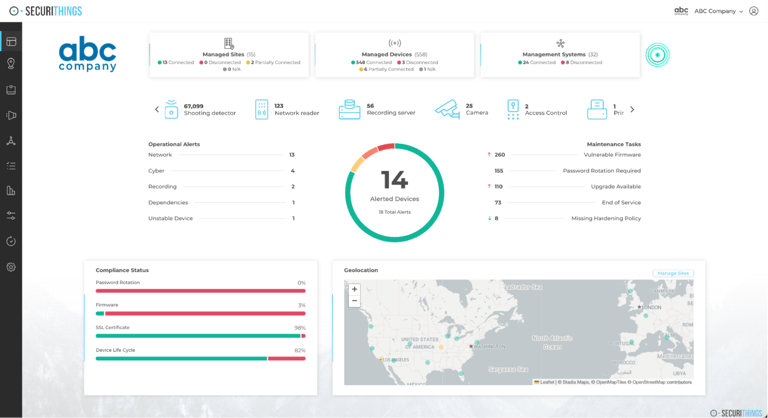
Automated, unified device operations. One view of fleet health, compliance status (passwords, firmware, certificates, lifecycle), active alerts, and maintenance tasks, integrated with IT systems for faster remediation and audit-ready evidence. (Source)
The Consolidated stage connects the dots, full device visibility, and automation at scale across cameras, VMS/NVRs, access readers, and network assets. Security signals (uptime, events, policy status) flow into shared IT monitoring and ticketing, so incidents create a single case with evidence attached as they occur.
Finally, collaborative programs treat security data as an enterprise resource. Security, IT, InfoSec, and compliance work from the same dashboards and runbooks; information-sharing is routine; business owners consume security signals for staffing, space, and maintenance decisions. At this stage, security becomes a strategic partner.
The table below maps the five stages to the program's structure, how it runs, and what you can measure at each step.
| Stage | Program characteristics | Data & Process | Outcomes / What to measure |
|---|---|---|---|
| Reactive | Fire-fighting; outages noticed during incidents | Manual evidence pulls; no centralized inventory | Audit pass/fail, incident count, unknown downtime |
| Preventive | Manual checks; siloed visibility by site/system | Spreadsheets; periodic health audits | Fewer surprises; high labor overhead |
| Automated | Continuous health/firmware alerts within silos | Basic automation per system; limited correlation | Lower mean time to resolution (MTTR) per system; still many handoffs |
| Consolidated | Unified view across devices, VMS, access, and network | Shared monitoring/ticketing; one incident = one case with evidence | Higher uptime; faster response; cleaner audit trails |
| Collaborative | Enterprise-ready information-sharing across stakeholders | Shared dashboards/runbooks; governance cadence; privacy-by-design | Measurable impact on throughput, utilization, and user experience |
Treat the model as a management cadence, not a one-off exercise: pick two or three moves for the next quarter (e.g., unify device inventory, route health/events into IT monitoring, formalize a shared runbook), set simple KPIs for each stage (camera uptime %, MTTR for access alarms, audit evidence turnaround), and review progress monthly with security, IT and InfoSec, and compliance.
Last thoughts
Physical security becomes a strategic business driver only when the underlying devices and workflows are healthy, secure, and connected to day-to-day operations. Cameras, access readers, and supporting services deliver value when they are visible in inventory, online, and compliant, with current firmware, protected by strong credentials and certificates, and monitored through clear ownership and runbooks.
Achieving that standard requires treating the estate as a managed fleet, which involves automatic discovery of all physical security devices, continuous health and configuration monitoring, policy baselines for passwords, certificates, logging, and retention, coordinated change control for firmware and configuration updates, and evidence collection that ties actions to audits. Centralized management also aligns security with IT and cybersecurity, provides shared dashboards, tickets, and KPIs, so signals flow into the systems teams already use, and collaboration becomes routine.
By providing comprehensive device discovery, continuous health and policy monitoring, at-scale firmware and certificate management, and integrations with ITSM/SIEM/monitoring tools, SecuriThings helps enterprises keep fleets functional, compliant, and available, so physical security data is trustworthy and ready to power business outcomes. The payoff is higher uptime, faster time-to-fix, stronger audit posture, and smoother collaboration across physical security, IT, and cybersecurity teams.